.svg)


Finding small warehouse space in Minneapolis that actually fits your business needs requires market knowledge. The Twin Cities metro is home to 17 Fortune 500 companies — more per capita than any other major U.S. metro — and a dense Medical Alley cluster employing more than 500,000 Minnesotans. That concentration drives outsized demand for logistics and storage space.
Small warehouse options under 5,000 square feet can be hard to find. Choose the wrong submarket, and you'll waste both time and money. Whether you're an e-commerce seller scaling inventory or a medical supplier needing proximity to major accounts, understanding your options matters.
The Minneapolis Small Warehouse Market
The Twin Cities industrial market is large, but overall vacancy sits at just around 5% as of the first quarter of 2026. Small-bay multi-tenant properties, the kind small businesses actually need, run even tighter. Most new construction delivers large-format distribution buildings that serve national retailers and e-commerce giants, so small warehouse space remains scarce.
E-commerce sellers, medical suppliers, contractors, light manufacturers and food distributors all compete for the same small pool of available units. Understanding where to look and for which amenities can save you months of searching and thousands of dollars in lease commitments that don't fit your growth trajectory.
Minneapolis Small Warehouse Submarkets Compared
Location matters more than you might think. Here's how the four primary submarkets stack up for businesses seeking top small-warehouse options and locations in the Minneapolis area:
Arden Hills and the Northern Suburbs
Arden Hills stands out as the strongest all-around option for small businesses serving the broader Twin Cities region. The I-35W and I-694 interchange puts you within 15 minutes of downtown Minneapolis and St. Paul, making distribution to both urban cores fast and efficient. Proximity to Medical Alley anchors like Medtronic, Boston Scientific and 3M gives suppliers and service providers a genuine business advantage — you're close to where decisions happen, and orders ship.
Finding a warehouse in Arden Hills that's minutes from MSP International Airport simplifies shipping nationally or receiving inventory from overseas suppliers. Costs run lower than urban cores while you're still central enough to reach customers across the metro without adding significant drive time. For businesses that need a balance of access, proximity to major employers and reasonable rates, Arden Hills delivers.
St. Paul Midway
St. Paul Midway works well for businesses that need to split time equally between Minneapolis and St. Paul. The I-94 corridor provides direct access to both downtowns, and the dense commercial district puts suppliers, services and labor close by.
Monthly costs run higher than in the northern suburbs, though, and much of the available building stock predates modern logistics infrastructure. Climate control, dock-height loading and high ceilings are harder to find. If your customer base sits squarely in both urban cores, the location justifies the premium — otherwise, you're paying more for convenience you might not fully use.
Eden Prairie and the Southwest Suburbs
Eden Prairie serves businesses focused on the western and southwestern suburbs, plus the tech corridor along I-494 and Highway 169. The customer base here tends to be affluent, which can translate to higher-margin sales if that's your target.
This is the priciest small warehouse submarket in the metro, though. Small businesses operating on lean margins often find it difficult to justify the premium when Arden Hills or Midway offer comparable access at lower monthly rates. Distances from the Minneapolis and St. Paul cores also add up quickly if your operations lean downtown-heavy.
Northeast Minneapolis
Northeast Minneapolis appeals to creative businesses, artisan manufacturers and makers drawn to the neighborhood's energy and walkable arts district. The community vibe is strong, but this is the most constrained submarket for small warehouse availability.
Gentrification has driven rents up significantly while most existing buildings predate modern logistics amenities like climate control, loading docks and high ceilings. Businesses that need functional warehouse infrastructure — not just character — tend to get priced or squeezed out quickly.
Key Amenities to Prioritize
With Minnesota's climate, the right warehouse amenities are critical. Here's what separates a functional warehouse from a frustrating one:
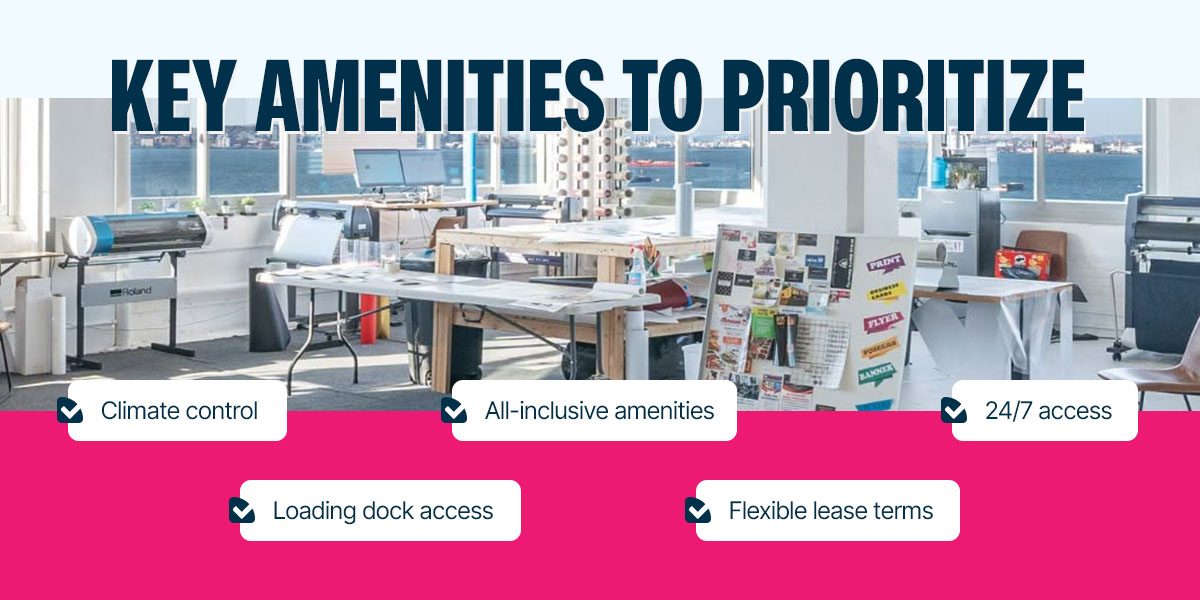
- Climate control: Minnesota winters regularly push low temperatures, with historic lows reaching -41°F in the Twin Cities alone. Products, packaging, adhesives and electronics all suffer in unheated spaces. Climate control protects inventory, keeps adhesives workable and ensures your team can actually function during winter months.
- Loading dock access: Grade-level doors and dock-height access for carrier pickups are essential if you ship and receive regularly. Without proper loading infrastructure, you're manually lifting pallets and boxes in sub-zero weather, which slows operations and increases injury risk.
- 24/7 access: Business doesn't follow a 9-to-5 timeline, especially in e-commerce and distribution. Look for facilities with keycard or security code entry that let you work early mornings, late nights or weekends without restrictions.
- Flexible lease terms: Traditional leases can lock businesses into multiyear commitments, which can strangle a growing business or leave you paying for space you've outgrown. Look for short-term options that let you adjust as your inventory and staffing needs change.
- All-inclusive amenities: When utilities, Wi-Fi, coworking access, on-site staff and carrier pickups are bundled into one monthly rate, budgeting becomes straightforward, and surprises disappear.
Standard Rental Pricing Breakdown
Base rent is only part of the story. In the Twin Cities, asking rents range from about $8 to $11 per square foot, quoted as triple net (NNN) — which means property taxes, insurance and common area maintenance fees are not included.
For a 1,000-square-foot space at $10 per square foot NNN, you're looking at $10,000 annually in base rent plus $3,000 to $5,000 in NNN charges. This brings your true cost to $13,000 to $15,000 per year before utilities, internet or any other operating expenses. Those add-ons make budgeting difficult and leave businesses vulnerable to surprise cost increases.
For businesses comparing shared versus dedicated warehouse costs, the transparency alone is worth the comparison.
Find Small Warehouse Space in Minneapolis With Portal Warehousing
Arden Hills offers the best value — freeway access, proximity to Medical Alley and lower costs. St. Paul Midway works for businesses serving both cities, Eden Prairie serves the southwest at premium rates, and Northeast Minneapolis has energy but tight availability. The right submarket depends on where your customers are and where your business is heading.
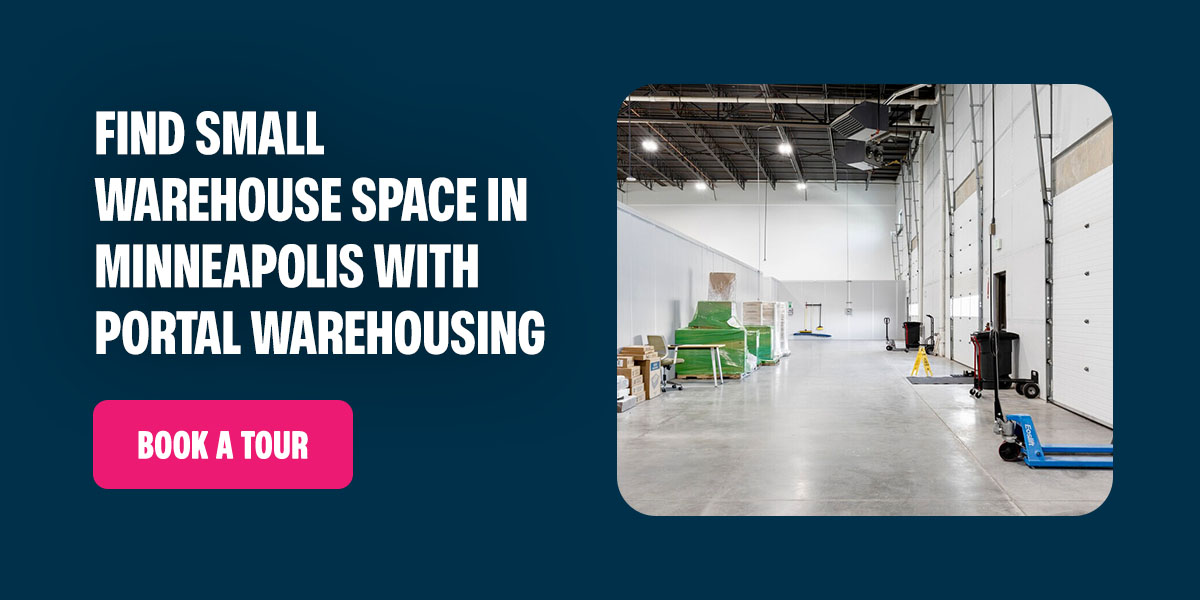
Portal Warehousing specializes in flexible, move-in-ready warehouse space for small businesses and startups. We make it easy to scale with month-to-month terms and transparent, all-inclusive pricing. Beyond the logistics, Portal creates a community where you can connect and network with other business owners who understand what it takes to grow — because building your business shouldn't mean doing it alone.
For most small businesses in the Twin Cities, Portal's Arden Hills location checks every box — central freeway access, move-in-ready units, flexible terms starting at three months and one all-inclusive monthly bill.
Tour Portal's Arden Hills warehouse or join Portal to start growing today.